
Before a robot can move reliably, it must learn how the real workspace maps to its internal frame. This process is called mapping. Once mapping is correct, a collaborative robot (cobot) can repeat tasks with stable, predictable motion, often with precision close to 100 microns (0.1 mm).
The core ideas behind that precision are plane and pose.
Plane: Defining the Robot’s Work Surface
The robot usually works over a physical surface: a tabletop, conveyor, fixture plate, or machined jig. In robotics, this surface is taught as a plane.
Teaching the plane tells the controller where X and Y lie on that surface, and which direction is normal to the surface (Z axis).
In many industrial cobot systems, a plane is taught using five points: three points define the geometric plane, while two additional points define the X/Y direction on that plane for consistent frame orientation.
P1
P2
P3   → used to compute the plane

P4
P5   → used to define the X/Y direction
The first three points must be non-collinear, meaning they cannot lie on a single straight line.

Mathematically, a plane in 3D can be defined using three non-collinear points: P1, P2, and P3. Then:
P1 (x1,y1,z1)
P2 (x2,y2,z2)
P3 (x3,y3,z3)

V1 = P2 − P1
V2 = P3 − P1

N = V1 × V2
That normal vector defines surface orientation, which becomes the reference for motion planning. The additional direction points help the robot decide how the X axis should run along the surface.
Why Precision Matters
If the taught plane is slightly wrong, the full coordinate frame tilts. For example, with a 0.1° tilt across a 500 mm workspace:
error ≈ 500 × tan(0.1°)
error ≈ 0.87 mm
That is 870 microns , a major deviation for precision automation.
In precision automation, that is a significant drift.
Dial Gauge for Surface Calibration
Teams often verify flatness and alignment with a dial gauge (dial indicator), checking surface flatness, fixture alignment, and robot base mounting accuracy. During calibration, sweeping the gauge across the surface helps confirm the deviation stays below the acceptable threshold.
- Typical sensitivity: 10 micron, and sometimes 1 micron resolution.
- Common target: surface deviation below 100 microns.
Surface deviation < 100 microns
Pose: Position + Orientation
Knowing where a target is not enough. The robot must also know tool orientation. A pose combines both position and orientation.
- Position: X, Y, Z coordinates of the tool center point (TCP).
- Orientation: rotation, often represented using roll, pitch, yaw.
Two poses can share the same XYZ and still behave differently if orientation changes.
| Pose | Position | Orientation |
|---|---|---|
| A | (300, 200, 150) | Tool vertical |
| B | (300, 200, 150) | Tool tilted 30° |
This is critical for screw driving, welding, angled grasping, and polishing. Even a 1° orientation offset can shift contact by several hundred microns depending on tool length and geometry.
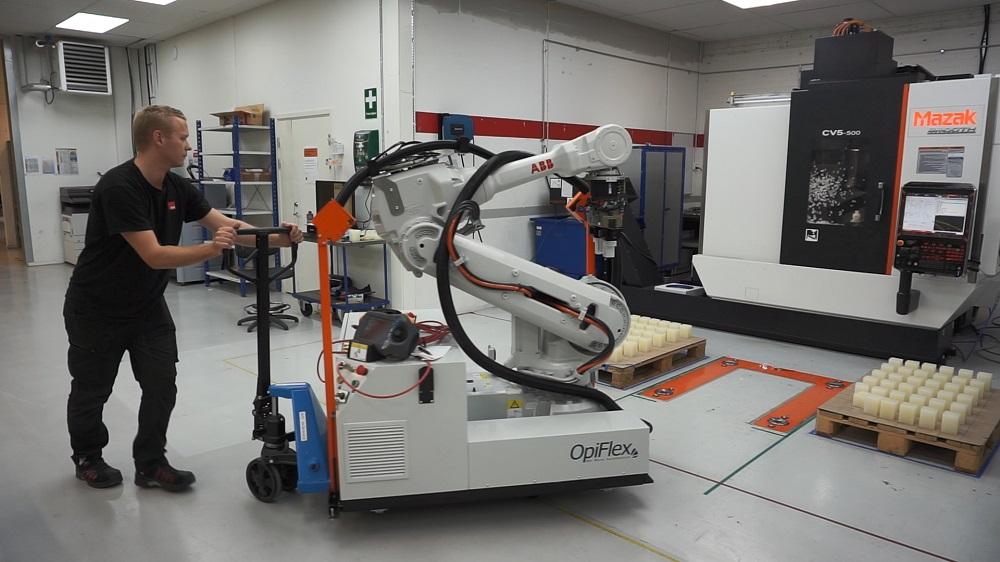
Precision in Practice: Why 100 Microns Matters
Industrial cobots often operate near ±100 micron repeatability. For context, 100 microns is 0.1 mm, while human hair thickness is roughly 70 microns.
100 microns = 0.1 mm
Human hair thickness ≈ 70 microns
Reaching that performance requires accurate plane teaching, correct pose definitions, stable mechanical setup, and verification with tools like dial gauges.
Closing Note
Mapping is the bridge between geometry and motion. When planes are taught accurately and poses include correct orientation, robot programs become easier to debug and far more reliable in production.
The difference between a drifting robot and a repeatable system is often just a few hundred microns of calibration quality.