Modern applications rarely run on a single server. Instead, they are built using many services running on different machines. This creates a new challenge , how do we make sure everyone sees the same data?
That challenge is called consistency.
What is Consistency?
Consistency means that all users see the same, correct, and up-to-date data , no matter where they access the system from.
If one user updates something, another user reading that data should not see an outdated or conflicting version.
In simple terms: a consistent system behaves like there is only one copy of the truth.
What is a Distributed System?
A distributed system is an application made of multiple components running on different networked computers. These components communicate with each other using messages to achieve a common goal.
Real-world Example: Online Book Store
Imagine an e-commerce system that sells books. Different services handle different responsibilities:
- Account Service: manages user profiles
- Payment Service: processes transactions
- Order Service: records purchases
- Inventory Service: tracks book stock
- Loyalty Service: manages reward points
When a user buys a book, multiple services must coordinate. This coordination is where consistency becomes critical.
Why Consistency Matters
Suppose only one copy of a book is left:
- Two users view the product page at the same time.
- User A buys the book.
- Inventory has not yet updated.
- User B also buys the book.
Now the system has accepted two orders for one item. This happens because different parts of the system had different views of reality.
Consistency patterns help prevent or manage such situations.
Consistency Patterns
Distributed systems use different strategies for managing data consistency. The three major patterns are:
- Strong Consistency
- Weak Consistency
- Eventual Consistency
Each pattern is a trade-off between correctness, speed, availability, and user experience.
Strong Consistency
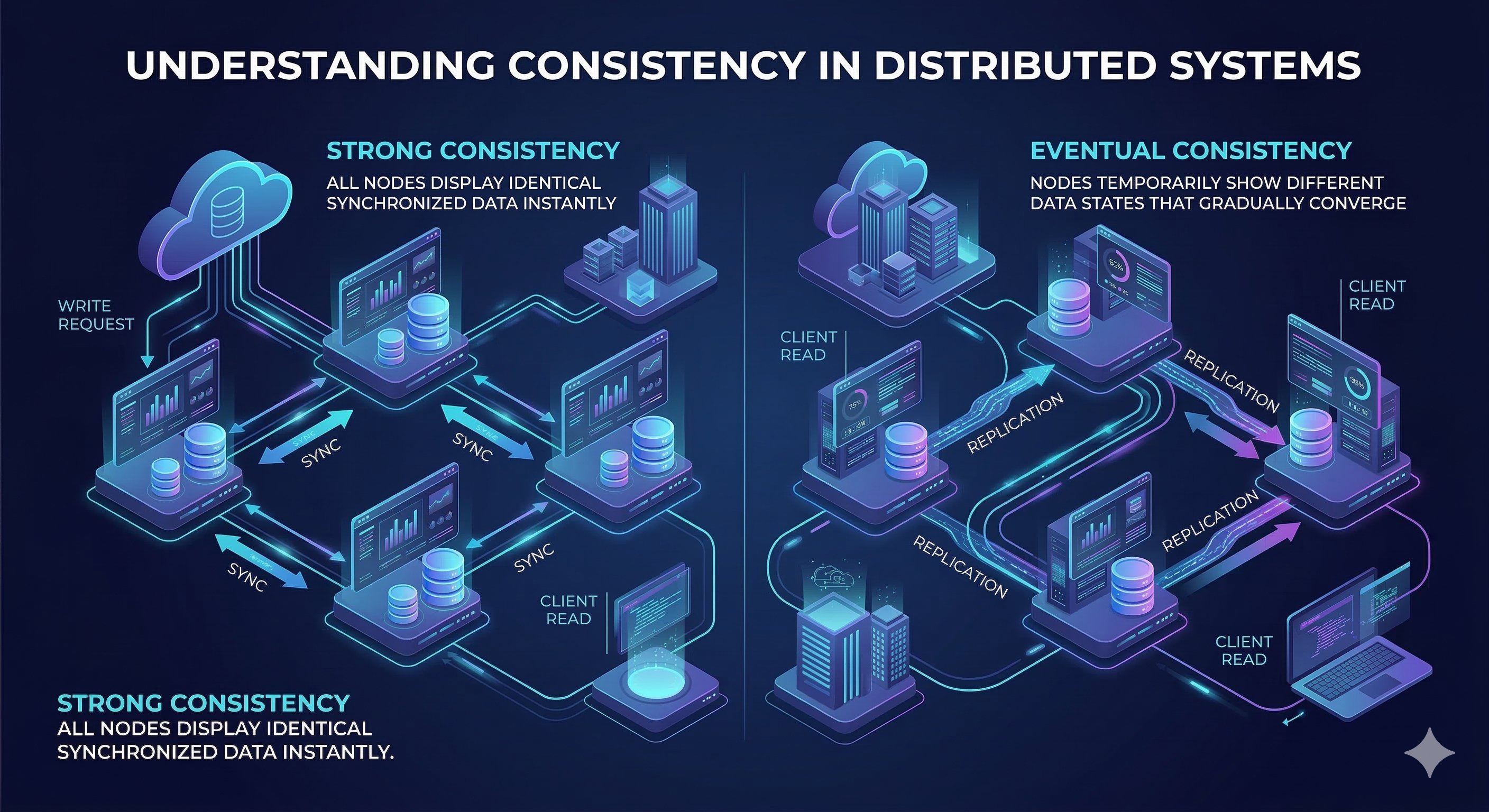
In a strongly consistent system, once data is updated, every future read immediately sees the updated value. There are no stale reads.
How it works
- Data replicas are updated synchronously.
- Reads may be delayed until writes are fully committed.
- System prioritizes correctness over speed.
Example: Banking system
- Balance must update instantly.
- No user should see the old balance.
- Double spending must be impossible.
This ensures high data integrity.
Trade-offs
- Higher latency
- Reduced availability during failures
- More complex coordination
Weak Consistency
In weak consistency, a read operation is not guaranteed to return the most recent write. The system allows temporary mismatches between data copies.
Example: Multiplayer online game
- Your movement is instantly visible to nearby players.
- Players far away may see a delay.
- Game continues smoothly despite minor inconsistencies.
Benefits
- Very low latency
- High availability
- Better real-time experience
Downsides
- Conflicting versions of data may exist
- Requires reconciliation logic
Eventual Consistency
Eventual consistency is a practical and widely used form of weak consistency. It guarantees that if no new updates occur, all replicas will eventually become consistent.
How it works
- Writes propagate asynchronously.
- Different users may see different versions temporarily.
- System converges to a single correct state over time.
Example: Social media platform
- Friends in your region see a photo instantly.
- Users in other regions may see it after a few seconds.
The system favors speed and availability over immediate global accuracy.
Trade-offs
- Temporary inconsistencies
- Possible conflict resolution logic
- Requires thoughtful UI design
Choosing the Right Consistency Model
There is no universally best consistency model. The right choice depends on business needs.
Use Strong Consistency when:
- Financial transactions
- Inventory management
- Ticket booking
- Critical data integrity
Use Eventual or Weak Consistency when:
- Social feeds
- Analytics dashboards
- Caching systems
- Real-time collaboration tools
Good system design is about making intentional trade-offs.
Final Thoughts
Consistency is fundamentally about maintaining a shared reality in a system that is physically distributed.
The more distributed your system becomes, the harder consistency becomes , and the more important design decisions become.
Great engineers do not chase perfect consistency everywhere. They apply strong consistency where correctness matters, and relaxed consistency where speed and scalability matter.